 LowLat
“Everybody talks about the speed-of-light,
but nobody ever does anything about it”
About the LowLat Project
Low-latency Distributed Information Access demonstrates that a World-Wide Web proxy cache can be used to proactively utilize available bandwidth to reduce access response time. The project will: (1) implement proxy mechanisms for Web performance measurement and experiments, (2) implement proxy mechanisms supporting proactive cache preloading, and (3) measure the efficacy of the mechanisms to support low-latency Web access.
LowLat uses a mechanism emulating a Web proxy cache for proactive caching using available bandwith, to reduce response latency.
The proactive caching mechanism is implemented in two parts: a cache supporting uninitiated remote loads, and a preloader supplying those loads. The cache is proximal to the browser, and the preloader is proximal to the server. Additional mechanisms monitor available bandwidth, cache load and space, server load, and preloading efficiency.
The techniques used in LowLat are based on general principles of communication latency from Mirage.
Related Work
Research Topics
-
Latency / BW requirements for an interactive Web
- An Architecture for An Interactive Web
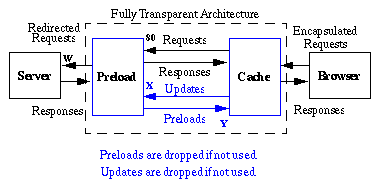
LowLat uses available bandwidth, either during idle periods on low-speed channels or excess capacity on high-speed channels to support server-side preloading of the receiver-side cahhe. In Lowlat, the conventional client/server interaction of the Web is augmented with a client-side “Filter Cache” and a server-side “Pump Preloader”. The client uses the filter as a local proxy, encapsulating web requests to the filter. The pump is used as a server-side cache, requiring relocation of the server to another port. The filter and pump interact as in the conventional Web, using conventional request-response on the well-known port. The filter allows presending on a separate port (plod), and the pump allows feedback (updates) on filter cache hits to direct the presending on a different port (updt).The Lowlat architecture is showed here:
     +--------+  8081 +--------+    8082 +--------+    80 +--------+
     |        |-ec r->|        |---req-->|        |--req->|        |
     | browser|       | filter |         |  pump  |       | server |
     |        |<-resp-|        |<--resp--|        |<-resp-|        |
     +--------+       |(proxy  |         | (proxy |       +--------+
                      | /cacge | 8083    | /cache |
                      | server)|<--pres--| server)|
                      |        |         |        |
                      |        |    8084 |        |
                      |        |--updt-->|        |
                      +--------+         +--------+
  redirect to proxy   (here.loc)         (here.remote)
  at here.loc:8082
      <-----------client----------|   |----------server----------->

                    FIGURE : LowLat architecture
-
Protocol for An Interactive Web
-
Algorithms for An Interactive Web
Data Structure for PRELOAD TREE on a pump;
Indexing caching data on a pump(data structure);
(Optional)Optimize the cache structure on both a filter and a pump
People
Joe Touch – Project Leader
Amy Hughes – graduate student
Publications
“Progress on the GBN ’94 ‘Five Challenges That Define High-Speed Protocols'”
- J. Touch, IEEE Gigabit Networking Workshop, Boston, MA, 1995.
“Report of the ARPA/NSF Workshop on Research in Gigabit Networking,”
- (member of authoring committee) , C. Partridge, Ed., Washington DC, July 20-21, 1994, <ftp.std.com:pub/craigp/report.ps>.
“Protocol Parallelization,”
- J.D. Touch, in Protocols for High Speed Networks IV, Ed. G. Neufeld and M. Ito, Chapman and Hall, London, 1995, pp. 349-360 (also ISI/RS-95-404).
“Defining `High Speed’ Protocols : Five Challenges & an Example That Survives the Challenges,”
- J.D. Touch, IEEE Gigabit Networking Workshop, Toronto, 1994.
Also in IEEE JSAC., special issue on Applications Enabling Gigabit Networks, Vol. 13, No. 5, June 1995, pp. 828-835 (also ISI/RS-95-408).
“An Experiment in Latency Reduction,”
- J.D. Touch and D.J. Farber, IEEE Infocom, Toronto, June 1994, pp. 175-181 (also ISI/RS-95-403).
“Parallel Communication,”
- J.D. Touch, IEEE Infocom, San Francisco, Mar. 1993, pp. 506-512 (also ISI/RS-93-342).
“Reducing Latency in Communication,”
- J.D. Touch and D.J. Farber, Letter to the editor IEEE Communications Magazine, Vol. 31, No. 2, Feb. 1993, pp. 8-9.
“Physics Analogs in Communications Models,”
- J.D. Touch, Proceedings of the Workshop on Physics and Computation, Physcomp ’92, Dallas TX, Oct. 1992, pp. 248-252 (also ISI/RS-93-301).
“Mirage: A Model for Latency in Communication,”
- J.D. Touch, Ph.D. Dissertation, Univ. of Penn, MS-CIS-92-42, DSL-11, Jan. 1992.
“Mirage: A Model for Ultra High-Speed Protocol Analysis and Design,”
- J.D. Touch and D.J. Farber, Proc. of the IFIP WG 6.1/WG 6.4 Workshop on Protocols for High-Speed Networks, Zurich, May 911 1989 (also U. Penn. MSCIS8979, DSL1).