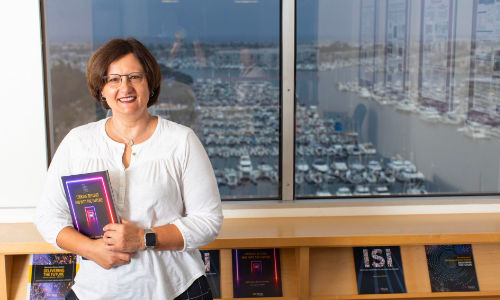
Kristina

Contact information:
USC Information Sciences Institute
4676 Admiralty Way
Marina del Rey, CA 90292

tel: (310) 448-8714
fax:(310) 822-0751


| personal  | projects |  publications  |  pursuits |


Personal Info
I am a research assistant professor at the University of Southern California's Computer Science Department and a project leader at the USC Information Sciences Institute. The road to CS has not been linear for me. I received a Ph.D. in physics from University of California at Santa Barbara, where I studied pattern formation in binary fluid convection. After a two year interlude in the software industry, I returned to academia as a computer scientist. My research interests are focused on two different topics: mathematical modeling of multi-agent systems and machine learning methods for information extraction and analysis.
More... | cv | family


Projects
Social Web and Social Computing
The label “social media” has been attached to a growing number of Web sites whose content is primarily user driven, for example, blogs, wikis, Flickr, Del.icio.us and Digg. The rise of social media underscores a transformation of the Web as fundamental as its birth. Rather than searching for and passively consuming information, users are now actively creating, evaluating and distributing information. In the process of using social media sites, users are adding rich metadata, such as tags, discussions, ratings and social networks, that will lead to a number of new information processing algorithms and a new generation of online collaboration technologies
More... | Social Information Processing Symposium
Mathematical modeling of agent-based systems
Mathematical analysis is a crucial tool for understanding emergent behavior of systems composed of many autonomous agents: robot or human. Analysis can be used to predict behavior of such complex systems, control them by finding parameters that optimize their performance and prevent undesirable behavior, and understand how individual agent characteristics affect emergent group behavior. We have developed a stochastic processes-based framework for mathematical analysis of multi-agent systems. We started by modeling simple agents that base their actions on their current state (e.g., reactive robots), and extended the theory to agents that consider past actions or interact with chemical fields. We successfully compared analytic predictions with experimental and simulations results in robotic domains such as foraging, collaboration and dynamic task allocation.

Our current research focuses on design and analysis of more complex agents, including humans. We are developing a methodology for designing multi-robot systems that uses techniques from machine learning (grammar induction) to automatically synthesize robot's behavior rules from the specifications produced by the robot's designer. Once we have the behavior rules, we can invoke the previously developed framework to predict and optimize collective behavior of a group of robots executing the same rules.

We are also extending our formal framework to agents that learn, adapt or interact with neighbors. Human beings display such complex behaviors. In one project, we are studying crowd dynamics in a museum setting. Together with collaborators at USC and Brandeis, we are modeling collective behavior of museum visitors and validate these models experimentally by recording actual museum visitors at the California Science Center in downtown Los Angeles. In another project, we are studying dynamics of social networks found on the recently proliferating social media sites. The label ``social media'' describes Web sites whose content is driven primarily by users: e.g., blogs, MySpace, del.icio.us, Wikipedia. The recent rise of social media sites underscores a transformation of the Web from a passive searchable medium to one in which users are actively creating, evaluating and distributing information. Social media sites allow us to methodologically study collective self-organization in humans, specifically, how users collaboratively evaluate information quality.

More...| Robot Swarms |Human Crowds| Task
Semantic Modeling of Information Sources
I am also part of the Information integration group at ISI. My research deals with automatically recognizing the semantics of data types used by various information sources. In the past, my research focused on automatically creating and maintaining wrappers that extract information from semi-structured information sources, such as Web pages. Because they use layout hints, such as HTML tags, in order to extract data, wrappers are sensitive to changes in page design, and therefore, break often. Automatic wrapper maintenance is the goal of my research.  I use machine learning methods to represent the data being extracted by the wrappers, which can then be used to detect source changes and to identify instances of this type of data in the new source.
More...| Mercury: Automatic Source Modeling | Wrapper Maintenance | Information Integration Group


Pursuits

outdoors...| skiing | watersports| photography | travel
arts... | music| literature
thoughts... | parenting | Web, etc.| experiments

Last Modified: 04/04/2006
Kristina Lerman
Copyright: USC Information Sciences Institute 1998-2006