What is a NEFSI?
To understand what a NEFSI is, you first need to know what a Radio Dynamic Zone (RDZ) is, as defined by NSF's SII-NRDZ. A RDZ is a physical area that can dynamically control how spectrum is used, ensuring protection for incumbents while also allowing robust spectrum sharing between participants.
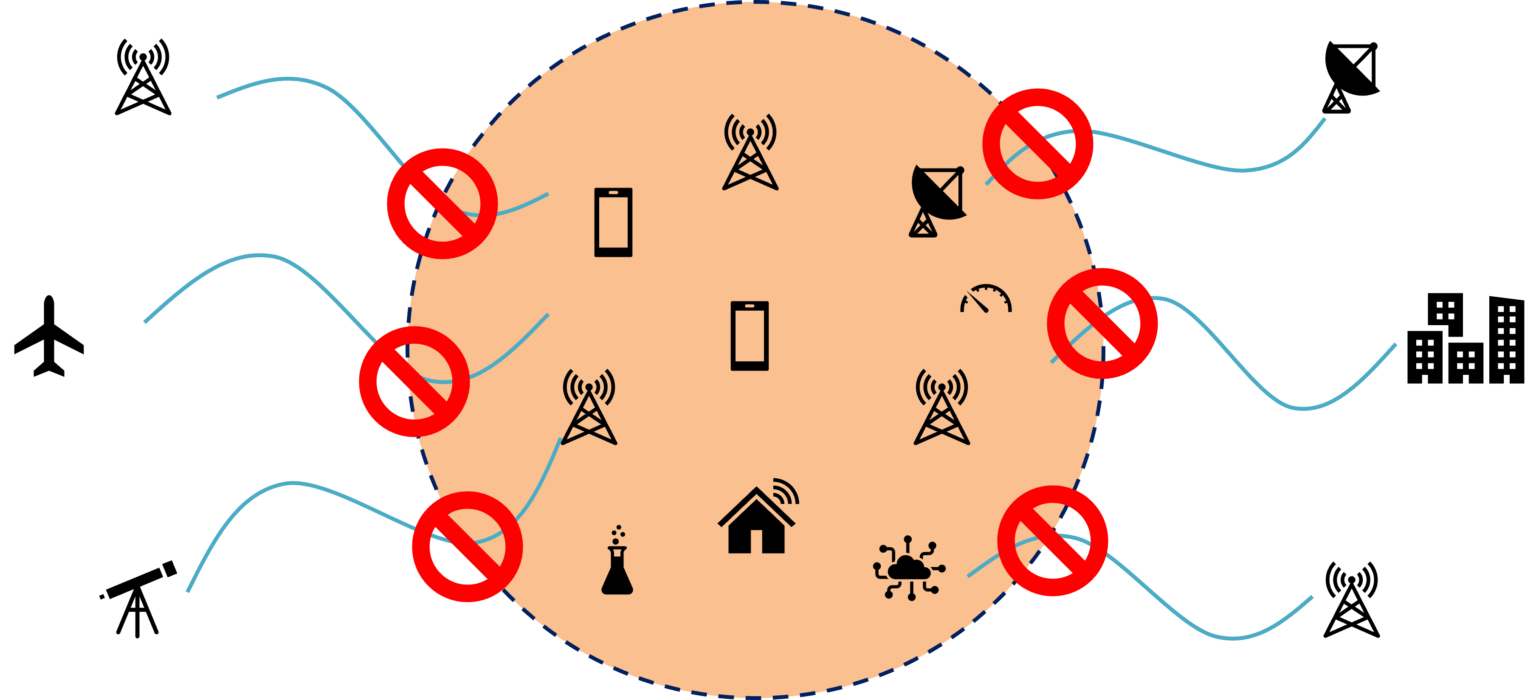
The NEFSI as a RDZ
A NEFSI is a special RDZ designed specifically for spectrum experimentation and innovation. As shown in the above figure, the NEFSI RDZ is where broad spectrum research can be conducted. However, the NEFSI must prevent any of these experiments from interfering with external incumbents and also ensure any external RF transmission is not contaminating any running experiment.
The STRATA Project
As stated, STRATA's goal was to determine the applicability of Idaho National Laboratory (INL) as the potential NEFSI. The team includes PI Dr. Erik Kline of USC-ISI and Co-PI Samuel Edwards of INL. To determine the applicability of INL as a NEFSI, the STRATA project undertook the following actions:
- Determine the requirements for any NEFSI to accomplish the goals of NRDZ.
- Discuss how to construct a greenfield NEFSI and identify any potential research gaps. This includes creating a "minimum viable product" (MVP) NEFSI which is not fully capability but allows a good starting point
- Enumerate INL's current capabilities, how they map to the NEFSI requirements and any specific gaps.
- Create plan to close INL's gaps and achieve a MVP NEFSI at INL. Further, create a path forward from MVP NEFSI to a more capable NEFSI.
- Design a NEFSI reference architecture which can be used to build the software and hardware ecosystem at any potential NEFSI site. This includes basic designs for all components and a enumeration of APIs
The STRATA Report
The result of the STRATA project is the STRATA report, which describes all our findings for each of the five areas above. This report is here: STRATA Final Report
Funding
This work was funded by the U.S. National Science Foundation through award AST – 2232390