Overview
Sharing the RF spectrum is a critical need, however the inability of receiver processing hardware to jointly meet high performance and agility requirements has been a roadblock to fully achieving this vision. Waveform agility and low power waveforms have made a priori receiver processing optimizations obsolete, requiring more computationally complex cyclostationary, correlation, and Machine Learning (ML) algorithms to detect, classify, and mitigate natural and intentional interference. Highly programmable RF front ends have increased wideband frequencies from megahertz (MHz) to gigahertz (GHz), scaling the number of signals to process. Meanwhile, the RF software environments and programming models have not evolved to capture advances in Artificial Intelligence (AI). A revolutionary advancement of autonomous RF spectrum signal processing systems is needed to provide the adaptive, highly performant, real-time processing required.
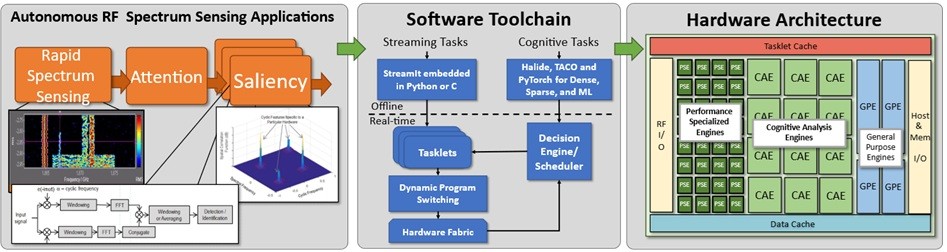
To address these challenges, USC/ISI, teamed with MIT, NYU, USC ECE, and Shared Spectrum Corporation (SSC), is researching and developing TRACER, the Tasklet Reconfigurable Agile speCtrum procEssoR. Our approach utilizes high performance heterogeneity, tasklet-level switching, and on-chip scheduling and resource management to develop a highly agile, highly performant RF accelerator capable of processing 0-40GHz of RF bandwidth.
TRACER: The Tasklet Reconfigurable Agile Spectrum Processor