Projects

Cooperative Multicast and Broadcast at the Tactical Edge
COMBAT enables link‑layer cooperation for wireless multicast by using opportunistic relay nodes to forward packets at high MCS rates, turning two high‑rate hops into much higher effective throughput compared with single‑hop base‑rate multicast.
Visit Website

SpaceCubeX
SpaceCubeX extends a prior automated trade‑space framework to add GPU support, model distributed sensors and high‑bandwidth links, develop prototype hardware, and demonstrate technologies required for multi‑satellite NASA Earth Science missions that demand 10–110× more onboard compute and complex on‑board communication, control, and intelligent sensor processing.

Independent Functional Testing of Commercial FPGA Devices
Independent functional testing of commercial FPGAs is an important first step in establishing a trusted supply-chain, determining the usability of devices stored in inventory, and monitoring the health status of fielded systems.

Hardened Adversarial Challenge (HAVoC)
The HAVoC project advances VET goals by producing large, real‑world benchmarks and full‑scale implementations that let independent third parties evaluate vetting methods—separating defense development from performance assessment to avoid bias and enable scalable testing.
Visit Website
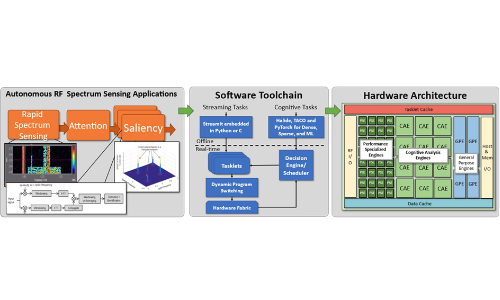
Tasklet Reconfigurable Agile Spectrum Processor (TRACER)
Sharing the RF spectrum is hampered by receiver hardware that cannot simultaneously deliver the performance and agility now required—advances in waveform agility, wideband programmable front ends, and AI‑driven detection/classification demand far more complex, real‑time processing, so a revolutionary, autonomous RF signal‑processing approach is needed.
Visit Website

TREBUCHET: A High-Powered Processor for Cutting-Edge Encryption
Fully Homomorphic Encryption (FHE) enables computation on encrypted data—enhancing security by avoiding decryption—but is roughly 100,000× more computationally intensive than unencrypted processing, so the TREBUCHET custom co‑processor seeks to accelerate FHE workloads and reduce the performance gap to about tenfold.
Visit Website
Pegasus Workflow Management System
The Pegasus project provides technologies that let workflow‑based applications run across desktops, campus clusters, distributed grids (PATh, OSG), supercomputing CI (ACCESS), and clouds by automatically mapping high‑level workflow descriptions onto available resources. It locates required input data and compute resources, shielding scientists from low‑level middleware details (HTCondor, SLURM, EC2) while coordinating multiple distributed infrastructures.

Embark: Evaluation of Mapping NLP based Alogrithms into Reconfigurable Computing Kernels
With advancements in high-speed interfaces, integrated DSP hard IP, and on-chip memory densities, FPGAs can leverage pipe-lining and parallelism to compensate for limitations like slower clock rates.
Visit Website

Panorama 360: Performance Data Capture and Analysis for End-to-end Scientific Workflows
Panorama 360 provides a resource for the collection, analysis, and sharing of performance data about end-to-end scientific workflows executing on DOE facilities.

Repository and Workflows for Accelerating Circuit Realization
Repository and Workflows for Accelerating Circuit Realization (RACE) is part of the DARPA CRAFT program, which seeks to develop new fast-track circuit-design methods, multiple sources for integrated circuit fabrication, and a technology repository delivered by RACE team, that will facilitate reuse of proven solutions.
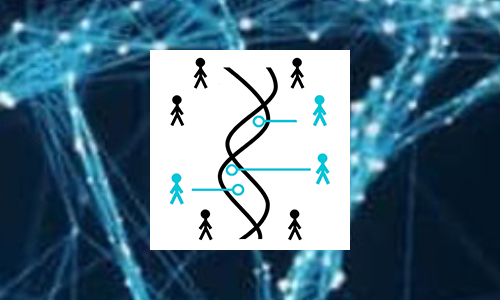
Population Architecture using Genomics and Epidemiology (PAGE)
The PAGE Study was designed to characterize the genetic architecture of complex traits among underrepresented minority populations through large-scale genetics and epidemiological research.
Visit Website

Model Integration through Knowledge-Rich Data and Process Composition (MINT)
Addressing major societal and environmental challenges requires integrated forecasting of natural and human systems, but combining models across disciplines today demands resolving semantic, spatio‑temporal, and execution mismatches—often done manually and taking over two years of human effort.
Visit Website

SimCenter: Center for Computational Modeling and Simulation
The SimCenter provides cutting-edge software to execute high-performance computational workflows, user support, and educational materials with the goal of advancing the nation's capability to simulate the impact of natural hazards on structures, lifelines, and communities.
Visit Website

Center for Collaborative Genetic Studies on Mental Disorders (CSGSMD)
The Center produces, stores, and distributes clinical data and biomaterials (DNA samples and cell lines) available in the NIMH Human Genetics Initiative. In addition, the Center creates tools that enables researchers to determine which samples or data might be of use to them, so that they may request access from NIMH.
Visit Website

Open Science Grid
OSG is a consortium dedicated to the advancement of open science via the practice of distributed High Throughput Computing, and the advancement of its state of the art.
Visit Website

XSEDE: Integrating, Enabling and Enhancing National Cyberinfrastructure with Expanding Community Involvement
Substantially enhance the productivity of a growing community of scholars, researchers, and engineers through access to advanced digital services that support open research; and coordinate and add significant value to the leading cyberinfrastructure resources funded by the NSF and other agencies.
Visit Website

WRENCH: Workflow Management System Simulation Workbench
WRENCH is a simulation workbench built on SimGrid for validated models and fast execution. Design, validate, and stress-test cyberinfrastructure at scale, then publish reproducible results with confidence.
Visit Website

In Situ Data Analytics for Next Generation Molecular Dynamics Workflows
This project tackles the data challenge of data analysis of molecular dynamics simulations on the next-generation supercomputers.
Visit Website
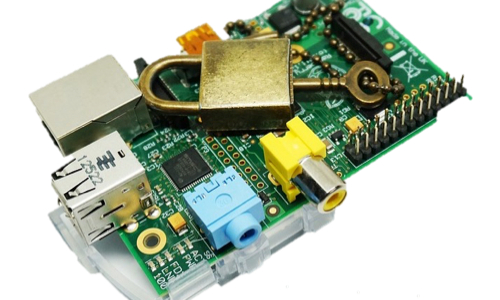
Mirage: A Security Metrics Driven Obfuscation Design Environment
Mirage provides a security‑driven design‑space exploration framework that evaluates and applies circuit‑level obfuscation techniques using quantitative security and overhead metrics, integrating with standard ASIC EDA tools to select, verify, and optimize realistic obfuscation strategies across large search spaces.
Visit Website