Optical Reef Team Presents at IAU Symposium
The Optical Reef team at the Space Engineering Research Center recently presented at the International Astronomical Union’s 2026 Symposium: Advancing the Search for Technosignatures. Optical Reef is a multidisciplinary research endeavor aiming to bridge the gap between large, assembled space telescope apertures and the precision required to make viable observations in the visible spectrum. Optical Reef has many use cases, but the main objective of the presentation was to demonstrate Optical Reef’s application to the search for extraterrestrial intelligence (SETI) and begin to compare its theoretical capabilities against current direct observation techniques.
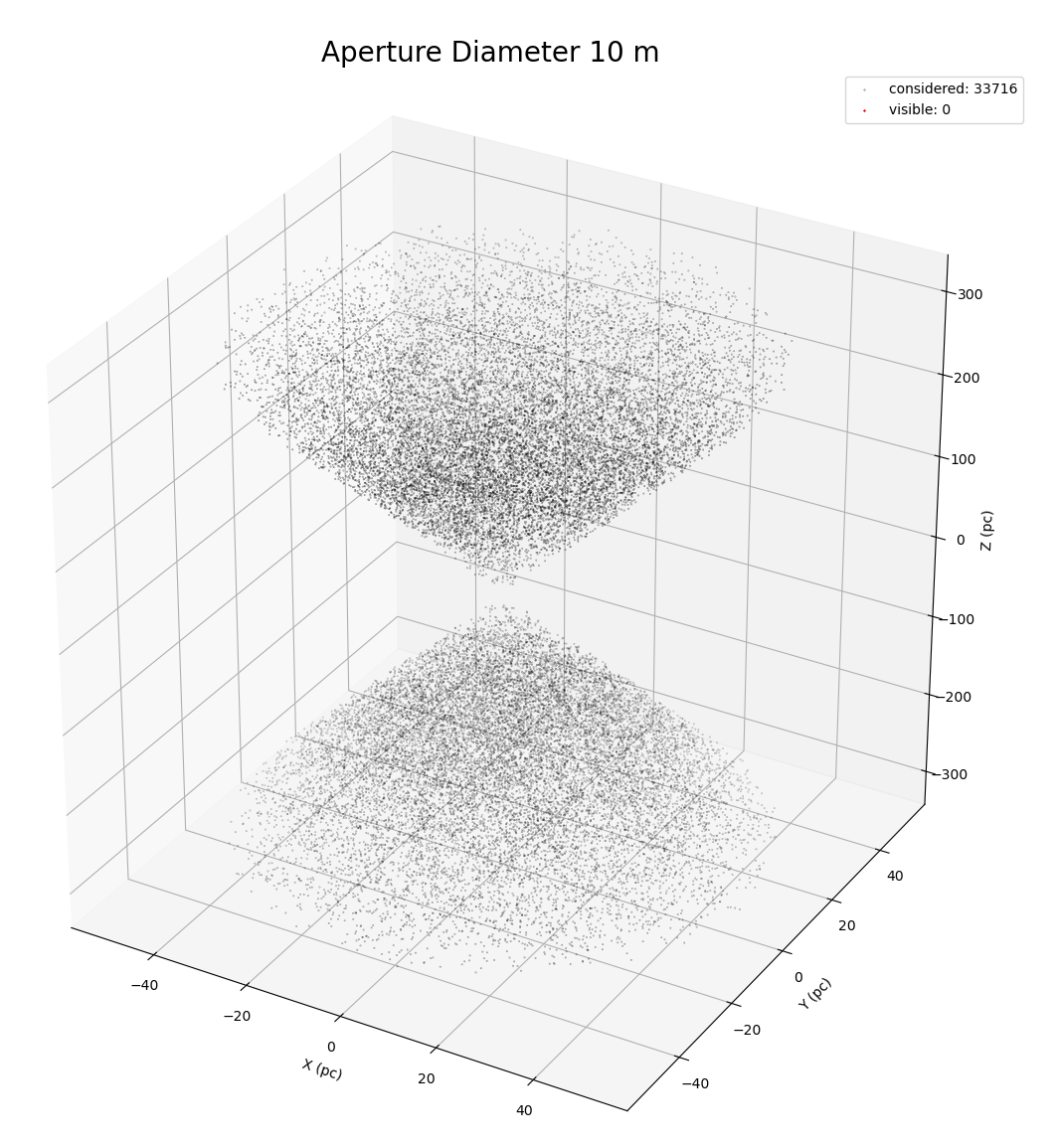
The team showcased simulation results which implied that Optical Reef, at its maximum aperture size of 1,000 km, could theoretically detect any habitable planets within 300pc. With even a small observation time of 10 minutes, Optical Reef could theoretically be able to directly image any candidate within this range. Notably, other large-aperture telescopes such as HabEx or LUVOIR-B would require observation times of more than 300hrs for viable signal-to-noise ratios (SNR). The ability to quickly obtain high-SNR exoplanet data could allow Optical Reef to contribute to further statistical quantification of certain terms in the Drake equation – an probabilistic formula which estimates the number of active, communicative extraterrestrial civilizations in our galaxy.
Monte Carlo simulations show that Optical Reef could maintain up to 16nm precision through the use of strategic mission design and adaptive optics techniques. With this precision, any exoplanet candidate within 300pc could be directly imaged with only a 10min observation time.
Nitrogen Dioxide (NO2) appears in higher concentrations in industrial areas, and is therefore studied as a technosignature on exoplanet worlds. Analysis was done to quantify Optical Reef’s ability to see this technosignature using NASA’s Planetary Spectrum Generator. The large aperture of Optical Reef enabled ultra-high SNR measurements of the signal, even for relatively low, Earth-like NO2 abundances on an exoplanet 10pc away.
Optical Reef is a pioneering effort in the field of large, assembled space telescope apertures and has showcased great potential for applications to the SETI mission.