SERC Researchers present their work at the 2026 AIAA SciTech Forum in Orlando


Cristobal Garrido and Jonathan Messer at the entrance of the 2026 AIAA SciTech Forum in Orlando.
At the 2026 AIAA SciTech Forum in Orlando, Florida, the Space Engineering Center at the University of Southern California (USC) delivered a series of technical presentations showcasing cutting-edge research in space robotics, soft robotic actuation, sensing, artificial intelligence, and experimental validation.
Research led by Griffin MacRae was featured in two separate presentations, both delivered by Joshua Pastizzo. The first, Design of Preloaded SMA-Driven Soft Robotic Limb With Onboard Thermal Sensing, presented in the Experimental Testing of Space Robotics Research and Development technical presentation, detailed the mechanical design and experimental validation of a compliant robotic limb driven by shape memory alloy (SMA) actuators with integrated thermal sensing. The work emphasized hardware-level insights critical to space robotics testing and development.
A second, distinct presentation titled Machine Learning Approaches to Position Estimation in SMA-Actuated Soft Robotic Systems was presented in the ML and AI for Space Robotics and Automation I session. This work focused on applying machine learning techniques to improve state estimation in SMA-actuated soft robots, addressing challenges associated with nonlinear behavior and limited sensing in compliant systems.
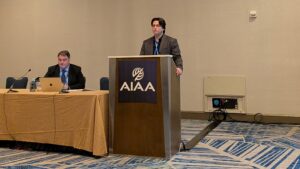
Joshua presented his work at the Experimental Testing of Space Robotics Research and Development technical presentation
Joshua Pastizzo also presented his own research, Sensor Contribution Analysis for Multimodal Estimation in Soft Robotic Actuators, in the Applications of AI/ML to Sensing and Fusion session, demonstrating how data-driven methods can quantify the impact of individual sensors on estimation performance.
Work by Jaxson Hill on Demonstration of Metrics for Self-Healing and Self-Reconfiguration in a Monolithic and Segmented Robotic System was presented by Cristobal Garrido in Novel Technologies for Space Robotics I session, introducing performance metrics for resilient and adaptive robotic architectures.
Cristobal Garrido also presented Sensor Fusion Techniques for Uncertainty Reduction in Rendezvous and Proximity Operations in Sensor Systems for Space Applications, highlighting approaches to improve robustness in autonomous spacecraft operations.
Completing USC’s contributions, Jonathan Messer presented A Parametric Design of a Nanonewton-Scale DMD-Driven Torsion Pendulum in the Novel Applications in Ground Testing technical session, showcasing a precision instrument for validating small-force dynamics relevant to space systems.
Together, these presentations underscored USC’s strong presence at SciTech 2026 and its leadership in advancing space robotics, intelligent systems, and experimental methodologies.
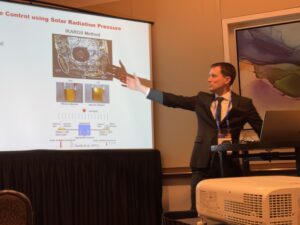
Jonathan presented his progress in the Novel Applications in Ground Testing technical session.