Latest News
ASTE anoints 4 SERC students to PhD Candidate status – Rise and Pursue Knowledge!
This past year, four Space Engineering Research Center (SERC) researchers achieved a major academic milestone by successfully passing their Qualifying Examinations in the USC Department of Astronautical Engineering. Passing the Qualifying Examination formally advances a doctoral student to the status of PhD Candidate, marking a critical step toward earning the distinguished title of Doctor of…
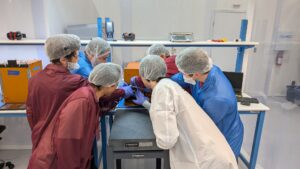
SERC Student Team Integrates USC’s 4th Satellite for 2026 Launch
The SERC and Department of Astronautical Engineering student team successfully integrated USC’s 4th satellite in its history to the launch deployer in San Luis Obispo MAVERICK Space Systems facility on June 10th! Under the guidance of SEOPS Space the team was guided throughout the integration lifecycle to culminate in the finish satellite locked and loaded…
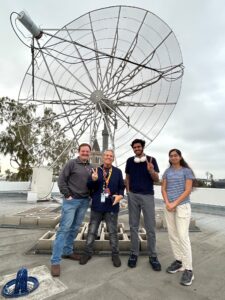
USC Astronautical Students Provide Support for NASA’s Artemis 2 Mission
As the world watches NASA’s Artemis 2 mission propel humanity back toward the Moon, a dedicated team of students from the Department of Astronautical Engineering ASTE-566 Class and the Space Engineering Research Center (SERC) is doing more than just observing—they are tuned in to the spacecraft’s very heartbeat. Chosen as one of approximately 40…
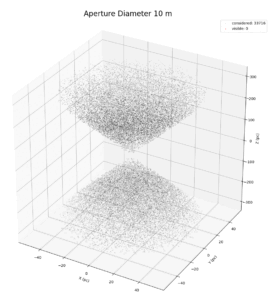
Optical Reef Team Presents at IAU Symposium
The Optical Reef team at the Space Engineering Research Center recently presented at the International Astronomical Union’s 2026 Symposium: Advancing the Search for Technosignatures. Optical Reef is a multidisciplinary research endeavor aiming to bridge the gap between large, assembled space telescope apertures and the precision required to make viable observations in the visible spectrum. Optical…
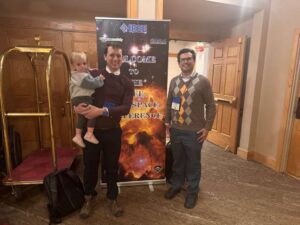
SERC Researchers Present at the 2026 IEEE Aerospace Conference
Researchers from the Space Engineering Research Center (SERC) at the University of Southern California presented their latest work at the 2026 IEEE Aerospace Conference, held in Big Sky, Montana. The conference is a premier international venue that brings together experts from academia, industry, and government to discuss advances in aerospace science and engineering. Two SERC…

SERC Researchers present their work at the 2026 AIAA SciTech Forum in Orlando
At the 2026 AIAA SciTech Forum in Orlando, Florida, the Space Engineering Center at the University of Southern California (USC) delivered a series of technical presentations showcasing cutting-edge research in space robotics, soft robotic actuation, sensing, artificial intelligence, and experimental validation. Research led by Griffin MacRae was featured in two separate presentations, both delivered by…
SERC Showcases Groundbreaking Space Research at IAC 2024 in Milan
Nine SERC students presented six groundbreaking research papers at IAC 2024, showcasing USC’s pioneering work in space exploration.

Haley Topper Farewell
On September 28, we cheered for Haley Topper as she accepted a job at Millennium Space Systems, celebrating her amazing journey at SERC!

CLINGERS: A Successful RPO Engagement on the ISS
SERC's first successful RPO engagement.

USC ISI/SERC Hosts Korean Businesses interest in Space
Prof Barnhart hosted over 26 professionals from Korea sponsored by the Korea Institute of Human Resources Development in Science and Technology (KIRD).