ISI News
Building a Better Transistor
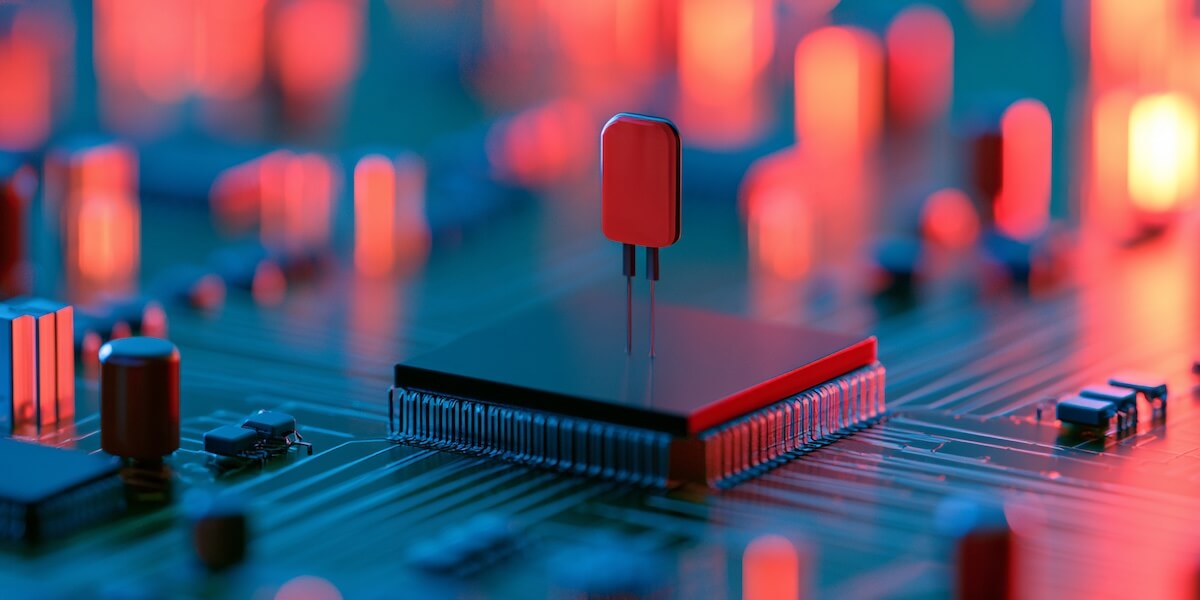
For more than half a century, the transistor has driven the digital age. Billions of these tiny switches fill computer chips, powering everything from phones to artificial intelligence.
But that engine is reaching its limits. Moving electrical charge through billions of transistors consumes enormous amounts of energy and generates heat. As computers become more powerful, they require even more electricity to operate and stay cool. Additionally, excess heat can slow or damage chips and limit how much computing power engineers can pack into a small space.
Ajey Jacob, director of advanced electronics at USC’s Information Sciences Institute in the USC Viterbi School of Engineering and the USC Stevens School of Computing and AI, believes the answer is not simply to improve today’s transistor. He wants to build a new one.
That goal is at the heart of SWIFT, short for Spin-Wave Injection Ferro-elastic Transistor, a three-year, $5.5-million DARPA-funded project led by Jacob, who also oversees ISI’s Application Specific Intelligent Computing Lab and is a research professor in the Ming Hsieh Department of Electrical and Computer Engineering. Instead of moving electrical charge to process information, a SWIFT transistor would use tiny waves of magnetism.
If it works, the technology could fundamentally change how computers operate. It could produce smaller, faster and less expensive machines that use dramatically less energy and release far less heat. Data centers could cost less to operate, while phones and satellites could run longer.
“The world is going to benefit from these transistors,” Jacob said.
Computing with ripples
SWIFT would carry information through “spin waves,” also called magnons. Jacob compares them to ripples crossing a pond: the wave travels across the surface, even though the water itself largely stays in place. In the proposed transistor, ripples of magnetism would travel through an extremely thin material.
Because the computing itself would happen in the waves, rather than in the movement of electrical charge, a calculation could take a fraction of the power conventional electronics require.
Jacob’s research team, which includes professors from UCLA, Rice University, the University of Wisconsin-Madison and Cornell University, aims to create a transistor that operates at room temperature and can be manufactured using the same processes as conventional computer chips.
That compatibility could leverage much of the existing semiconductor manufacturing infrastructure. The new transistor would also be reprogrammable, allowing it to perform one task and later be reconfigured for another. That could reduce the need for separate hardware dedicated to each function.
That flexibility is only one potential advantage. SWIFT could also help address one of computing’s most urgent problems: its growing appetite for energy.
The environmental stakes are rising, particularly as AI drives growing demand for data-center computing. By using less energy and generating less heat, Jacob said, SWIFT transistors could reduce computing’s environmental footprint.
GPS as the proving ground
The team’s first planned demonstration is a processor for Global Positioning System signals. GPS receivers constantly compare faint signals from satellites with known patterns. The researchers believe SWIFT’s waves can carry out that matching naturally, quickly and with little energy.
Their projection is striking: a SWIFT-based GPS processor could be about 18,000 times more energy-efficient than a conventional digital version if the device reaches its target metrics.
The scientists also believe a fast, reprogrammable processor could help GPS equipment resist jamming, deliberate interference meant to overwhelm or block weak satellite signals. A receiver able to rapidly change how it searches for and processes signals, Jacob said, could better adapt when interference appears.
That capability could help military aircraft, vehicles and other systems continue operating in hostile environments, where losing GPS can endanger both equipment and lives, he added.
SWIFT is not yet a working transistor. “The single result I’m waiting for is proof that a magnetic wave, or a spin wave, can strongly change the electrical resistance,” Jacob said. “That is needed to prove this.”
Jacob predicts the team will demonstrate a proof of concept in about 18 months.
A career spent reinventing chips
An academic with extensive industry experience, Jacob has spent more than two decades developing transistors and chip technologies, including stints at Intel and GlobalFoundries.
He holds more than 300 patents worldwide, but SWIFT stands apart because it could change the basic physics underlying computation and open a path beyond the energy and heat barriers slowing conventional chips.
For Jacob, proving SWIFT would be more than another successful invention. It would validate a lifelong drive to extend what computers can do while reducing the resources they consume.
“It would be one of the crowning achievements in my life,” he said.
Published on September 15th, 2026
Last updated on October 1st, 2026