ISI News
From USC to Microsoft: A Career Shaping AI’s Next Era
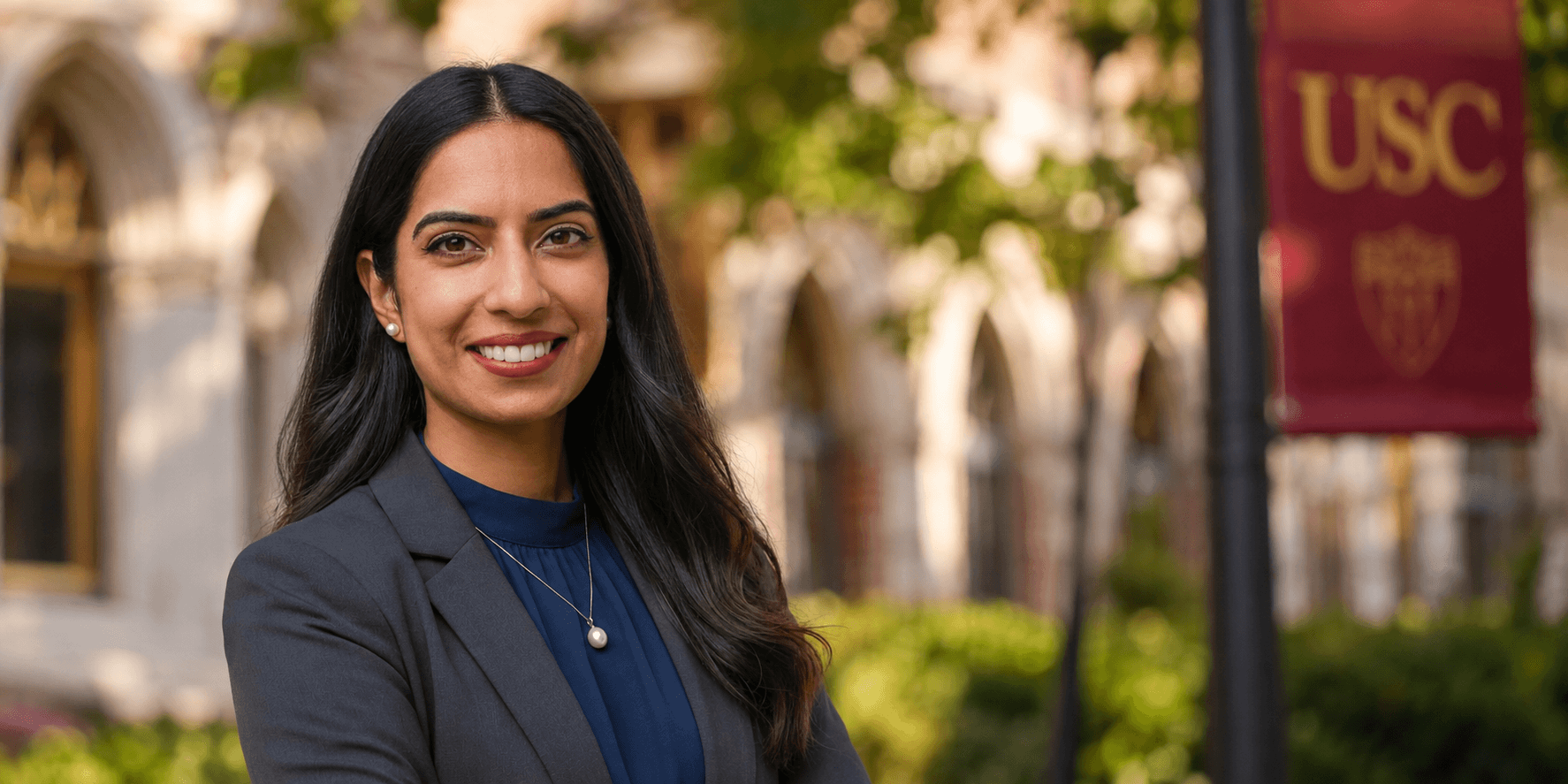
At 11, Priya Bhasin taught herself to code and built a small program to automate billing for a family business — an early taste of what she’d spend two decades pursuing: computers handling tasks well enough people didn’t have to think about them.
Now, as a Group Product Manager at Microsoft AI, she’s working on the latest stage of an arc her whole career has followed: the web’s evolution from helping people find things, to helping them choose, to AI agents that increasingly act on their behalf. Her own path traces that progression one company at a time — and it started with a USC Viterbi degree.
Bhasin came to USC for a master’s in computer science with an AI/ML specialization, drawn by the university’s Information Sciences Institute (ISI), its dedicated AI research lab, and its location in California’s tech industry. She had offers from schools with lower tuition. “The benefits of the research lab like ISI and being in Silicon Beach outweighed the higher tuition fee,” she says. Her path there began with a detour: an internship in Brazil modeling traffic flow through São Paulo ahead of the 2014 World Cup. “I wanted to put myself in an environment where I could learn as much as possible and be closer to where new technology was being built,” she says.
The USC Foundation
At USC, technical training and community reinforced each other. Bhasin found a network of international students who pointed her toward exciting industry opportunities and played a critical role in grabbing internships. “All my peers at USC, especially the international community, were really warm and welcoming,” she says. “Anytime I had a question, I could reach out to students above my year and get real insights.” She went to nearly every Indian Association event on campus and TA’d two algorithms courses, just to stay close to undergraduate energy — she remembers grading sophomore projects to build robots that danced at the football stadium on game day. USC’s career center taught her to be intentional in an industry with too many directions to chase. “There are so many opportunities everywhere, it’s like drinking from a fire hose,” she says.
The habit that stuck longest came from an operating systems class: build much of an OS from near-scratch. Bhasin and two classmates hacked through the night before the deadline. “My peers were so smart, we kept building on top of each other’s ideas,” she says. Their project ranked first, and all three are still friends today. One of them, Neeraj Narang, now a Staff Software Engineer at Meta, remembers her raising questions about privacy and trust years ahead of the industry, in the same class where they built a search engine together. “Priya pushed all of us to think beyond whether the technology simply worked and consider whether it truly served the people using it. She raised the bar for everyone around her,” he says. “I’m proud, but not surprised, to see Priya become an industry leader in this field, developing search, digital advertising, and AI systems that balance relevance and economic value with privacy and user trust.”
Another class taught her a habit she still relies on. In an AI course, her assignment was to build a program that could solve Kenken, a Sudoku-style logic puzzle. “What that coursework taught me was breaking complex problems into smaller, testable ideas,” she says, “instead of being intimidated by having to build the thing all at once. “That’s very similar to how I think about building AI agents today. An agent doesn’t solve a complex task in one giant leap—it breaks the goal into steps, reasons about what to do next, uses the right tools, evaluates the result, and keeps going.”
From Engineer to Product Leader
That same collaborative instinct carried her into product leadership. “Engineers are figuring out how it gets built,” she says. “PMs are figuring out what gets built. I had an inclination to influence what gets built.” She’d actually interviewed at Apple for an engineering role, but told the VP the truth: “I love Apple as a company. I’d love to build products as a PM.” Weeks later, Apple came back with a product role instead — and Bhasin spent the next eight years building privacy-preserving search relevance for the App Store: the “find” problem of connecting someone with the most relevant result.
At Moloco, she moved to the next stage: personalization and marketplace quality, the “choose” problem of helping someone tell which option is right for them, while protecting user privacy and giving advertisers enough transparency to decide.
The Work Now
At Microsoft AI, Bhasin is now working on the “act” stage of that same arc: systems that don’t just recommend, but act. “I didn’t want to just read about it in the news,” she says. “I wanted to be part of the front and center of where AI is taking shape.”
The change is almost comic: she’s automated pieces of her own life with it. “I’ve automated ordering gifts for our family,” she says. She built another PM-focused AI agent — she calls him Alfred — that reads thousands of her teams threads each week and drafts her team updates. “My leaders didn’t know this,” she says, “but they were saying Priya writes the best weekly snippets. And I had to tell them: this is the agent writing it.”
Worth the Investment
Even as she automates her own job, Bhasin doesn’t buy the argument that college is becoming irrelevant in the age of AI. “Universities are still a really important part of who you are and become,” she says. “It’s not just the academics, which of course you can learn through AI now. It’s the whole ecosystem — learning from other peers, learning the discipline to complete your assignment on time, building that work ethic.” “What will change, though, is you can’t let yourself be defined only by a particular job title or a technology specialization anymore and roles become more fluid,” she says. The coolest job titles the year she graduated aren’t necessarily today’s top earners. “The ability to learn, to reason clearly, to have good judgement and understand people, will remain valuable. You do learn that from the university ecosystem.”
Her advice to a student considering the same path is simple: “Look for problems that genuinely interest you, get really good at explaining why they matter, and seek out experiences that stretch you beyond your strongest skills.” She compares the arc to hiking toward a summit that looks too big to reach. “But if you take it step by step, the journey becomes simpler, and you enjoy it more,” she says. It’s the same instinct that once got her through an operating systems project at USC at two in the morning, certain it wouldn’t come together. It did — and, one step at a time, so has everything since.
Published on October 7th, 2026
Last updated on October 7th, 2026