ISI News
Class Of 2026 Trojan Engineers Tasked As Trustworthy Problem-Solvers As They Launch Next Chapter

On May 15, 2026, more than 950 graduates walked the Galen Center’s stage at the USC Viterbi School of Engineering commencement ceremony, officially closing one chapter and opening another.
In his speech to the crowd of thousands, Dean Yannis C. Yortsos framed graduation as the start of a larger adventure: “America at 250 years old is an unfinished journey toward ideals that each generation must re-earn. You will be the most important part of this story. And the problems you will solve, in a human-centric, skillful, and ingenious way, will be what makes this nation come closer to its founding ideals. We will count on you. And we are certain that you will make us proud.”

Dean Yannis C. Yortsos delivering remarks at the 2026 Undergraduate Commencement (Photo Credit: Magali Gruet)
Yortsos quoted British quantum physicist David Deutsch, stating: “There will always be problems. But all problems are solvable.” However, he also challenged graduates to see themselves as more than technical experts. “At USC Viterbi, you learn that the world needs not only problem solvers; it also needs trustworthy problem solvers, those who combine competence with character. A trustworthy engineer is the world’s most powerful force for good.”
For Dean Yortsos, that ethos has been put into practice through his emphasis on the Grand Challenges Scholars Program, for which he received the prestigious Gordon Prize from the National Academy of Engineering in 2023. Moreover, throughout his 21 years as Dean, Yortsos has been a leading advocate for changing the conversation about engineering. This year, 27 percent of the undergraduate class are international students from 35 countries, and 42 percent are women.
“You are, by every measure, the most representative class in this school’s history,” stated Dean Yortsos. “You are changing the conversation about engineering: who we are, what we do, what we look like.”
With characteristic grace, the Dean encouraged students to thank those who have supported them throughout the journey: the teachers and mentors, the families and friends. Drawing from his own Greek heritage, he referred to a phrase attributed to Alexander the Great: “I am indebted to my father for living, but to my teacher for living well.“ He also invoked the character of Penelope from Homer’s Odyssey, who represents the loved ones who will stay steadfast in their support as student engineers continue the adventure, their Odyssey.

Class of 2026 Undergraduate Commencement (Photo Credit: Magali Gruet)

Class of 2026 Undergraduate Commencement (Photo Credit: Magali Gruet)
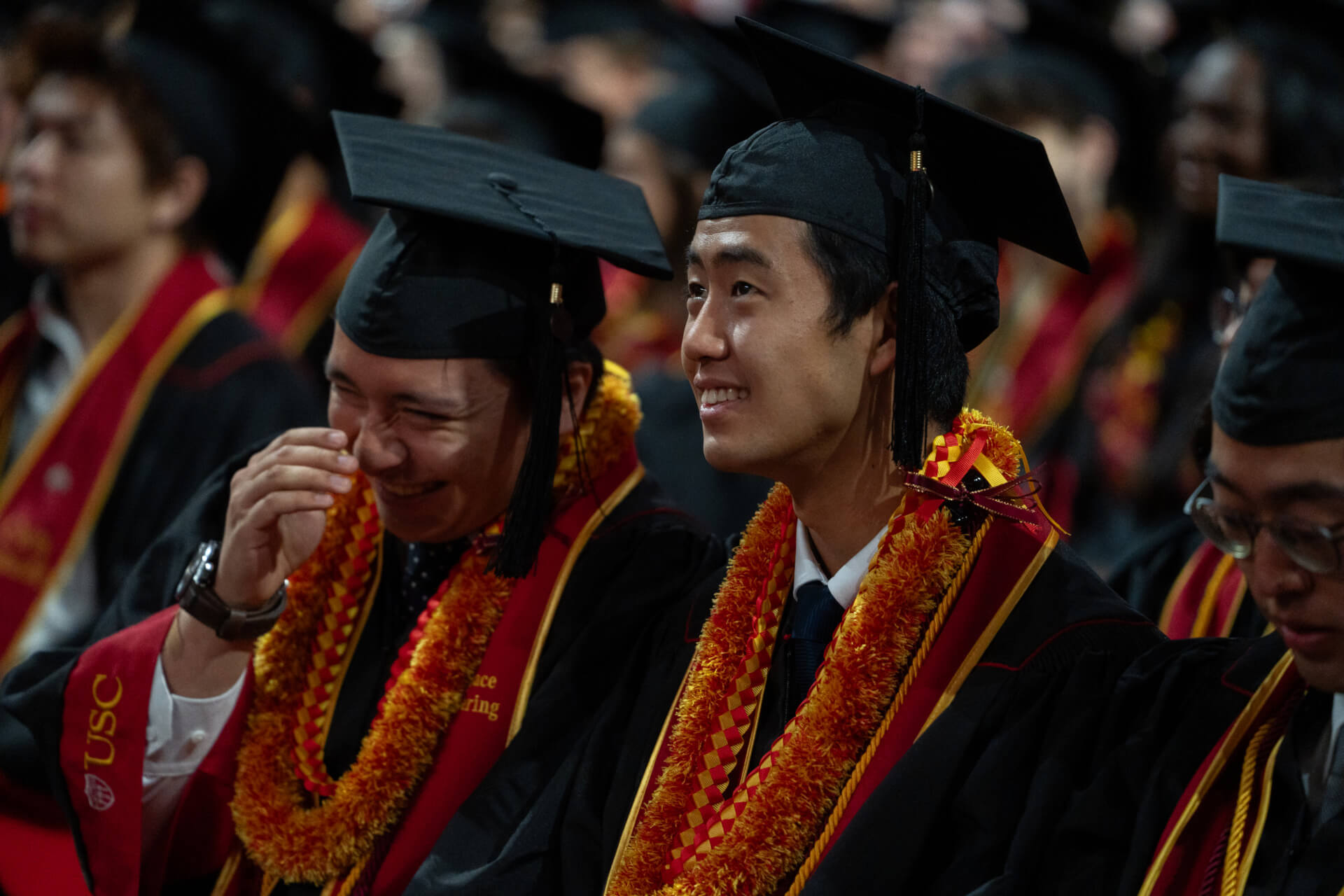
Class of 2026 Undergraduate Commencement (Photo Credit: Magali Gruet)
USC Engineering Graduates as Trustworthy Problem Solvers
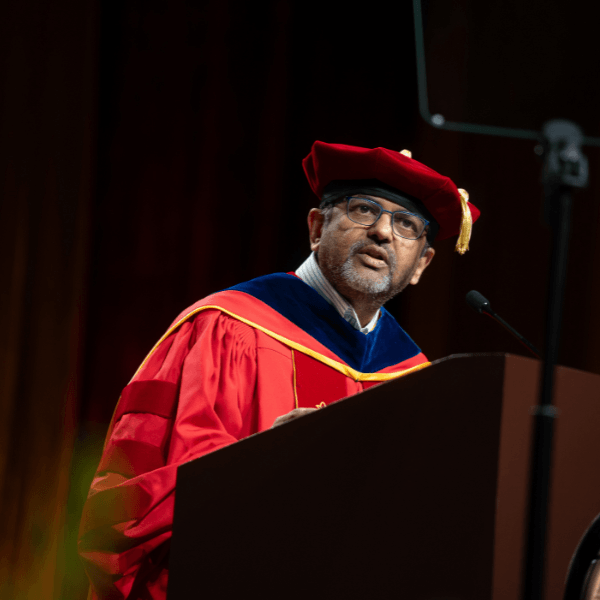
Executive Vice Dean and Director of the USC Mark and Mary Stevens School of Computing and AI, Gaurav Sukhatme delivering remarks (Photo Credit: Magali Gruet)
Executive Vice Dean and Director of the USC Mark and Mary Stevens School of Computing and AI, Gaurav Sukhatme said “commencement is not an end but a new beginning.” Echoing Yortsos, he reflected that commencement literally means “a new beginning.”
This commencement was especially significant as it marked the very first ceremony since the announcement of the newly named USC Stevens School.
“These recent rapid advances, particularly in AI, called for a rethink of how we teach at the university and how we do research,” Sukhatme said, explaining that the USC Stevens School is USC’s answer to that call.
USC’s computer science department remains USC Viterbi’s largest department, with more than 480 graduates; importantly, Sukhatme also emphasized that computation is the foundation powering advances across every engineering discipline. He said that in the coming years, students will help build a community of scholars dedicated to expanding the frontiers of computing.
Resonating with the theme of solving difficult problems, Class of 2026 undergraduate student speaker Jennifer Liu said “engineering is about being willing to sit with difficult problems, rethink your approach, and persist with grit,” as she delivers her remarks on stage in front of the graduating class.

2026 Student Speaker Jennifer Liu delivering remarks at the 2026 Viterbi Undergraduate Commencement (Photo Credit: Magali Gruet)
Introduced on stage by Senior Associate Dean for Admission and Student Engagement Kelly Goulis, Liu is a senior pursuing a computer science and business administration (CSBA) degree, a joint program between the Thomas Lord Department of Computer Science and the USC Marshall School of Business.
Liu also reflected on the importance of finding meaning through challenging conversations and wrestling with hard questions in an age increasingly shaped by AI.
Liu is the recipient of this year’s CSBA Outstanding Student Award and a Grand Challenges Scholars program designate. During her time at USC, Liu not only co-founded USC Avenue Consulting Group, conducted interdisciplinary research on AI and philosophy, and led the USC Society of Women Engineers but also served as a teaching assistant at Marshall.
After graduating this May, Liu will move to New York City to join McKinsey & Company as a business analyst.
Finding Human Voices in the Age of AI: Viterbi Graduates’ Role in Building Human-Centered Technologies
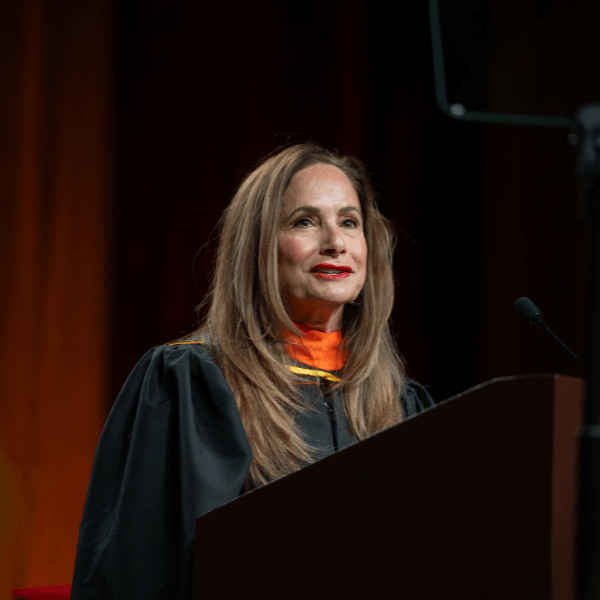
USC Viterbi undergraduate commencement speaker and CEO of Google Public Sector Karen Dahut delivering her remarks (Photo Credit: Magali Gruet)
In the age of AI, “nobody is better qualified to harness this technology than you,” commencement speaker and CEO of Google Public Sector Karen Dahut told the graduating class.
Dahut emphasized that while “AI is a powerful engine, it has no compass,” underscoring the human role in technological advancement because AI itself “does not have a heart or a soul.”
She said an engineer’s job is to determine the “why” behind the code and understand the weight of its impact on humanity.
As graduates step into the workforce, Dahut reminded them that “your job isn’t to use these tools — it is to shape them.”
She added that students will determine the “why” behind the code and, at the edge of a new creative renaissance, graduates are the ones holding the proverbial brush. “What will you do with it?” she asked the audience.
Many speakers throughout the ceremony echoed the importance of human-centered AI. The Dean encouraged students to embrace the next phase of AI “in a human-centric way for the benefit of humanity,” while Sukhatme noted that “the revolution in modern computing, powered by algorithms and data, is at the center of these changes, and you are leading this charge.” Liu also reflected that in an age of instant AI-generated answers, it is easy to mistake “truth for meaning.”
Returning to her alma mater as commencement speaker, Dahut reflected on how her USC Viterbi School of Engineering education was shaped not only by the classroom, but also by the campus environment itself.
“The timeless red brick grounded us, and the sunlit plazas of Viterbi inspired us to think beyond boundaries,” Dahut said. Looking around campus once again, she added that USC “didn’t just teach us how to build the future; its beauty inspired us to dream about it.”
Dahut also highlighted USC Viterbi’s “Engineering Plus” philosophy, a concept that combines technical mastery with social consciousness, entrepreneurship and interdisciplinary collaboration.

Class of 2026 Undergraduate Commencement (Photo Credit: Magali Gruet)

Class of 2026 Undergraduate Commencement (Photo Credit: Magali Gruet)

Class of 2026 Undergraduate Commencement (Photo Credit: Magali Gruet)

Class of 2026 Undergraduate Commencement (Photo Credit: Magali Gruet)
The Power of the Trojan Engineering Community
Liu highlighted the power of community throughout her remarks, describing USC Viterbi as a diverse community of thinkers, innovators and problem-solvers.
Passionate about bringing people together, Liu reflected on both the large and small moments that shaped her USC experience.
“Because along the way, we realized something else: none of us did this alone,” Liu said. “I saw the power of community in big ways, like serving as an officer for USC Society of Women Engineers. But I felt it just as much in the smaller moments — some of my most cherished memories are making dinner with my roommates or studying until 3 a.m. on a friend’s couch.”
The sense of gratitude and community was equally reflected when Yortsos asked students to rise and thank the people who helped them become engineers, including family members, friends and faculty mentors.

Class of 2026 Undergraduate Commencement (Photo credit: Noe Montes)
Next Chapter: Scenic, Detours, Taking Risks, and Embracing Uncertainty

Class of 2026 Undergraduate Commencement (Photo credit: Noe Montes)
“In a world where one of the only constants in life is change,” Liu reminded the audience reflecting that her class entered USC in the aftermath of the COVID-19 pandemic, a period shaped by uncertainty.
She encouraged her peers to savor the “scenic detours” and the journey itself rather than focus solely on a perfect destination, urging them to take risks.
“Your job at 22 is not to figure out your entire life,” was one of the key piece of advice Dahut offered graduates.
She reflected on her own career journey as she took the audience through the different seasons that shaped her path—from an office in the Navy to her role as CEO of Google Public Sector.
She emphasized that each season represented an “option” she gave herself by staying curious, anchoring herself to her purpose and taking risks.
Dahut told graduates that while “you may not always land a job you love, what matters more is finding beauty in the noise and purpose in what you do,” urging them to “stay open, stay curious, and take a few risks” as she concluded her remarks.

Class of 2026 Undergraduate Commencement (Photo Credit: Magali Gruet)

Class of 2026 Undergraduate Commencement (Photo Credit: Magali Gruet)
Published on May 17th, 2026
Last updated on May 18th, 2026