ISI News
USC Space Lab Opens Its Doors as A New Era of Space Competition Takes Off

USC’s Space Engineering Research Center, or SERC, has spent years building satellites, developing robotic systems and training the next generation of space engineers. Until now, much of that work has happened behind closed doors.
On Wednesday, July 15, SERC officially welcomed the public inside for the first time, hosting its inaugural open house at USC’s Information Sciences Institute in Marina del Rey. About 60 business leaders, entrepreneurs, and USC researchers and community members attended morning and afternoon sessions that offered a behind-the-scenes look at one of USC’s fastest-growing research centers.
Visitors toured laboratories, watched live technology demonstrations and met USC Viterbi students building robots, satellites and giant telescopes designed to explore the universe.
“I’ve been wanting to do this for a while,” said SERC director, research professor in the Department of Astronautical Engineering and cofounder David Barnhart. We’ve reached the point where we have enough exciting projects and enough students doing remarkable work things that it’s time for people to see what we’re doing,”
Starfish robots, massive space mirrors
During the open house, attendees got a firsthand look at the cutting-edge research underway at SERC. Graduate and undergraduate students demonstrated research projects, answered questions and explained how ideas developed in the laboratory could eventually become technologies used in space.
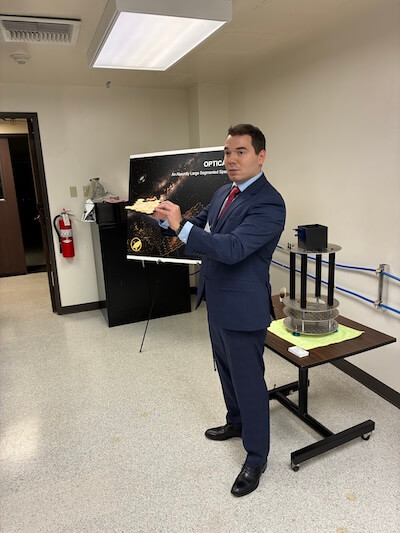
Ph.D. student Howard Hall discussing his vision for Optical Reef, a massive, segmented space mirror (Photo/Marc Ballon)
In the SERC optics lab, Ph.D. student Howard Hall discussed his vision for Optical Reef, a massive, segmented space mirror that could eventually stretch one kilometer across, exponentially larger than any mirror ever deployed. Hall compared such mirrors to “a bucket of light that takes light from faraway distant galaxies and focuses it on a single point.” By gathering more light from distant galaxies, giant mirrors would allow scientists to build much larger space telescopes capable of seeing farther, more clearly and at higher resolution.
As envisioned, rockets would individually transport hundreds of small mirrors into space, where they would be assembled into a giant aperture. Hall, an astronautical engineering doctoral student advised by Barnhart, said Optical Reef could transform humanity’s understanding of the universe.
“I’m incredibly excited because looking into the skies—looking into the universe—tells us where we’re from,” he said. “It answers all the fundamental questions of why we’re here, where we came from and whether there are other life forms out there. To be able to do this on a scale like this, I think, would be a great achievement.”
In a robotics lab, Isabella Pier, a SERC researcher and senior majoring in mechanical engineering, demonstrated Superbots. First developed in 2004 and continually refined since then, these fully modular, self-reconfiguring robots communicate with one another using infrared light to complete tasks, such as one day repairing broken satellites in space. The robots, she said, can also learn as they “go along.”

Kristina Andreyeva, a SERC, researcher and doctoral student, standing in front of the Starfish, a soft robot with four mechanical arms that might one day access hard-to-reach places to inspect space stations and perform other tasks (Photo/Marc Ballon)
Large crowds gathered in the soft robotics lab to watch a demonstration of the Starfish. More flexible than a traditional robot, the Starfish can move its four mechanical arms in several directions. In the future, a Starfish equipped with a camera might access hard-to-reach places to inspect space stations, peer inside space caves and even repair damaged satellites and spacecraft, said Kristina Andreyeva, a SERC researcher and doctoral student working with Barnhart.
“The Starfish is one of the first robots that moves using bio-inspired tentacles for crawling,” she said. By contrast, many rigid robots have wheels. And in space, “there are no roads for wheels to roll on.”
USC SERC is one of only a handful of institutions globally pioneering soft robotics.
A highlight of the morning session came when six SERC students on USC’s campus appeared live on a screen in Marina del Rey. The group was centered at USC’s Satellite Mission Control Center, used not only to operate satellites but to train students in satellite communications.
The students remotely maneuvered a large antenna atop the Ahmanson Center. Their goal: establish contact with Maveric, a shoebox-size 3U CubeSat designed and built almost entirely by USC students. The nanosatellite, which launched in July aboard a SpaceX Falcon 9 rideshare mission, will test a suite of next-generation space technologies, including 2D and 3D imaging for future satellite servicing, low-cost magnetic field sensing that could improve space weather data, and AI-enabled navigation systems.
Because it can take up to two weeks to locate a satellite as small as Maveric, Barnhart said he wasn’t surprised that the students couldn’t find it during the demonstration. However, “the fact that they successfully heard from another satellite proved that the ground system is working,” he added.
Preparing students for a changing space economy
Founded in 2009, SERC was created to bring together USC researchers, faculty and graduate students to solve some of the toughest engineering challenges in space. Jointly operated by USC’s Information Sciences Institute and the Department of Astronautical Engineering, the center is home to nine Ph.D. and 20 master’s students working on space-related technologies.
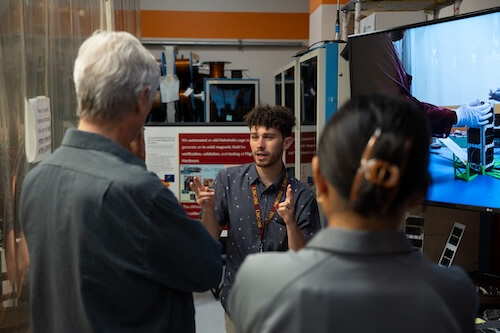
SERC open house visitors listening to a presentation (Photo/Magali Gruet)
SERC, unlike a traditional classroom, gives students the chance to work on projects with real customers and real deadlines. Barnhart said the center operates much like a teaching hospital.
“Medical students learn by working on live patients under the supervision of experienced doctors,” he said. “We do the same thing in engineering. Everything we do is hands-on. Students are working on projects for government and industry, or on new technologies that we believe will become important in the future.”
The timing couldn’t be better. Governments and private companies around the world are investing billions of dollars in satellites, lunar missions, space-based communications and national security, he said. As competition in space accelerates, so does the demand for engineers with real-world experience designing and building the technologies that will power future missions.
Barnhart said that is exactly why SERC exists.
“It’s specifically meant to bridge the gap between the academic skill sets that come out of university and practical transitions into industry,” he said. “We have to solve today’s problems while also inventing the technologies they’ll need tomorrow.”
Published on July 23rd, 2026
Last updated on July 23rd, 2026