NSF ACCESS Regional AI Workshop – SoCal Edition
The NSF ACCESS Regional AI Workshop – SoCal Edition invites researchers, educators, and students from across Southern California who are using - or curious about using - AI and advanced computing in their work. Whether you’re part of the ACCESS program, exploring NAIRR resources, or simply interested in practical AI tools and workflows, this free one-day, in-person event is for you.

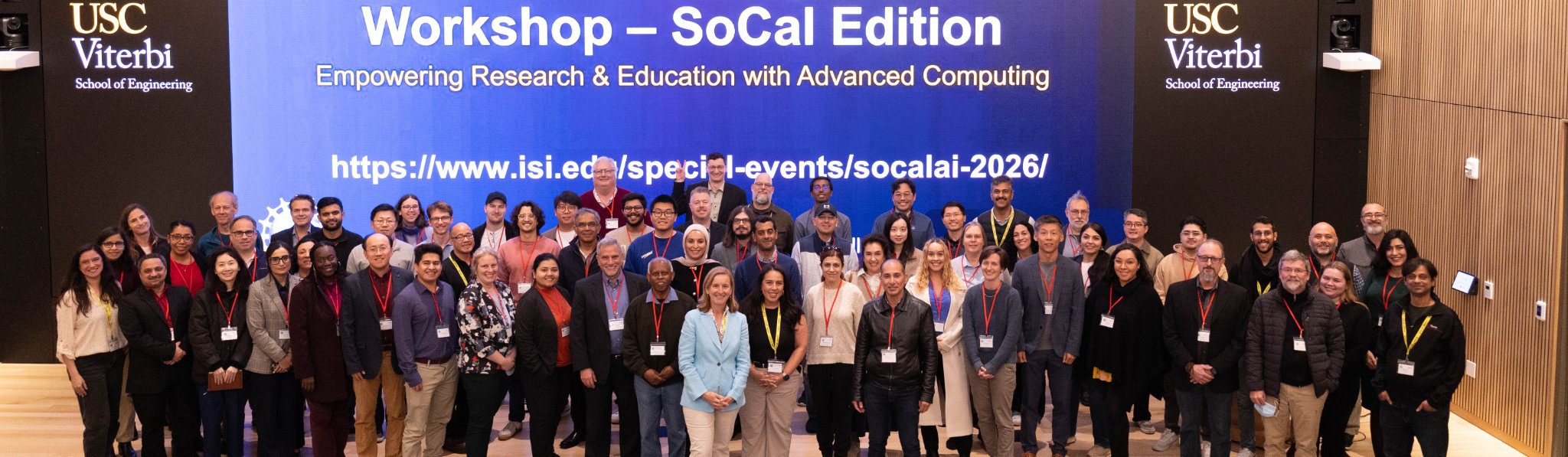
The NSF ACCESS Regional AI Workshop was held on January 28th, 2026 in Los Angeles, CA. Please click the button below to view photos from the event.
This ACCESS-Support led workshop will include presentations on the use of AI for research and education and provide an overview of NAIRR-Pilot, connecting practitioners in the Southern California region using the NAIRR-Pilot ecosystem. It will explore how to make the most of NAIRR allocations, highlight practical tools and workflows, and share strategies for advancing research across disciplines with AI. Participants will gain insights into best practices, hear about success stories from the community, and connect with peers to exchange ideas and foster collaboration.
The NAIRR-Pilot program is NSF’s flagship program about giving access to commercial and academic CI resources to researchers looking to conduct research in AI or applying AI to their science or education.
This workshop offers a unique opportunity to strengthen your AI skills, broaden your network, and become part of the growing regional AI community. The workshop will provide an opportunity to present lightning talks or posters.
Applications are now closed


How it Started
In April 2025, NAIRR held “AI Unlocked: Empowering Higher Education through Research and Discovery” in Denver, Colorado with about 350 attendees. Based on the success of the workshop, it was decided to hold NAIRR smaller regional focused workshops limited to about 100 attendees.The first one was RMACC (see agenda here) in Colorado in August 2025. A second workshop was hosted in Kentucky early October 2025. USC/ISI is organizing the Southern California Region workshop in January 2026.
Agenda
| Time | Topic | ||||||||
|---|---|---|---|---|---|---|---|---|---|
| 8:00 - 9:00 am | Check in and breakfast | ||||||||
| 9:00 - 9:10 am | Welcome - Ewa Deelman, University of Southern California |
||||||||
| 9:10 - 10:40 am | AI on Campus
|
||||||||
| 10:40 - 11:00 am | Break | ||||||||
| 11:00 - 12:30 pm | AI Resources
|
||||||||
| 12:30 - 1:30 pm | Lunch | ||||||||
| 1:30 - 2:30 pm | Lightning Talks: What Can You Do With AI? (10 min talks, 5 min Q/A)
|
||||||||
| 2:30 - 4:15 pm | AI Ready Data
|
||||||||
| 4:15 - 5:00 pm |
Focus Demo: Pegasus Workflow Management System - Karan Vahi and Mats Rynge, University of Southern CaliforniaAbstractPegasus WMS (Workflow Management System) streamlines the execution of complex AI and machine learning workloads by automating the end-to-end pipeline from data ingestion to model evaluation. Through ACCESS Pegasus, researchers can utilize a hosted workflow environment that simplifies the orchestration of jobs across distributed national cyberinfrastructure. This platform allows users to leverage pre-configured Jupyter Notebook examples and the Pegasus Python API to design reproducible AI workflows. To optimize the use of specialized hardware, Pegasus utilizes glideins (pilot jobs) to provide a unified overlay over GPU resources. This abstraction layer allows the workflow manager to treat diverse, distributed compute nodes as a single, coherent pool of resources. By deploying these pilot jobs, Pegasus can dynamically provision and manage high-performance GPU environments, enabling AI workloads to scale across multiple clusters while maintaining consistent performance and reducing the overhead typically associated with manual resource allocation. |
||||||||
| 5:00 - 5:05 pm | Closing Remarks - Ewa Deelman, University of Southern California | ||||||||
| 5:05 - 7:00 pm | Social Mixer / Poster Session |






Posters
A Multi-Task Benchmark for Detection, Segmentation, and Tracking in Aerial Videos - Sedat Ozer, California State Polytechnic University, PomonaDrone (aerial) vision remains a critical research topic across multiple application domains. Existing public aerial datasets predominantly provide bounding box annotations and largely lack dense, instance-level segmentation and long-term object tracking labels. While object detection in aerial imagery is increasingly well studied, joint segmentation and tracking in aerial videos remain underexplored due to the scarcity of richly annotated datasets. We present a novel UAV-based video benchmark that enables joint object detection, instance segmentation, and multi-object tracking in densely populated aerial scenes. |
ACOSUS - An AI-driven Counseling System for Transfer Students - Sherrene Bogle, Cal Poly HumboldtUnderrepresented transfer students face multifaceted academic, personal, and environmental challenges that are often insufficiently addressed by traditional university counseling systems. This project develops ACOSUS, an AI-driven student counseling system designed to complement existing advising by providing personalized readiness assessments, success predictions, and actionable recommendations. ACOSUS extends current counseling approaches in two key ways: (1) by integrating personal, behavioral, and environmental factors with academic performance data, and (2) by delivering individualized assessments of students’ preparedness for academic upskilling and job market success. The system employs natural language processing, deep neural networks, and other AI techniques, while incorporating bias-aware data curation methods to mitigate racial and gender biases common in AI-driven systems. The project consists of three thrusts: Thrust 1 conducts cognitive studies using surveys and interviews to identify factors influencing transfer decisions; Thrust 2 analyzes social media influences on transfer and career choices; and Thrust 3 integrates these findings to design, implement, and evaluate ACOSUS. |
Advancing NLP for Non-Latin Scripts and Languages - Adrianna Tan, Future EthicsAre We Leaving Non-Latin Scripts and Languages Behind? The vast majority of NLP research and Large Language Models (LLMs) are focused on high-resource languages, predominantly those using the Latin script (e.g., English, French). This creates a critical gap, leading to performance disparities, systemic biases, and the exclusion of billions of speakers from the benefits of advanced AI. The disproportionate focus on Latin scripts means biases and harms are often not adequately measured or addressed for non-Latin script users. Future work must be linguistically informed and strategically address the resource and structural gaps in order to bridge the gap, so that AI can serve billions of people more safely. In my poster presentation, I am actively seeking bilingual collaborators who are proficient in English and another language/script (especially those non-Latin scripts like Arabic, Hindi, Korean, Japanese, or others) to work on practical tools and research in this area. |
AI-Driven Framework for Personalized Insulin Dosing and Safer Diabetes Management - Yash Kishorbhai Pansheriya, California State University, NorthridgeType 1 Diabetes (T1D) management requires continuous monitoring and frequent decision-making under uncertainty, yet conventional insulin dosing formulas are static and often fail to account for dynamic factors such as meal timing variability, residual insulin activity, and physical activity.This work presents a machine-learning–based decision support framework for personalized short-term glucose prediction and insulin dosing explanation. The system integrates continuous glucose monitoring data with estimates of insulin-on-board, carbohydrate intake, and activity levels to forecast near-term glucose trajectories and classify glycemic risk zones. Based on these predictions, the framework applies clinically grounded rule-based logic to generate context-aware insulin dosing guidance, while explicitly enforcing safety constraints such as insulin-on-board and hypoglycemia risk. |
AI-Driven Molecular Structure Determination from Ultrafast X-ray Scattering - Roya Moghaddasi Fereidani, University of California San DiegoUnderstanding molecular structure and dynamics in real time is one of the grand challenges of modern physical chemistry. My research integrates artificial intelligence with quantum molecular simulations to reconstruct molecular structures directly from ultrafast x-ray scattering patterns. While forward simulations of x-ray scattering from known geometries are well established, solving the inverse problem—inferring atomic configurations from measured patterns—remains highly challenging. To address this, I am developing supervised machine-learning models, including convolutional and graph neural networks, trained on first-principles simulations to learn the mapping between scattering patterns and molecular geometries. Once trained, these models can rapidly predict transient molecular structures and distinguish between competing reaction pathways, providing an efficient alternative to traditional ab initio molecular dynamics. This AI-driven framework aims to accelerate the creation of molecular “movies” at femtosecond timescales, opening new possibilities for understanding and controlling photochemical reactions. |
Autonomous Self-Healing Memory Systems for Energy-Efficient and Reliable Computing - Marjan Asadinia, California State university, NorthridgeEmerging non-volatile memory technologies such as Phase-Change Memory (PCM) offer high density and scalability, but they face critical challenges related to high write energy, long write latency, and limited endurance caused by frequent bit transitions and write-disturbance errors. These limitations motivate the development of self-healing memory systems that can autonomously adapt to workload behavior and mitigate reliability degradation over time. This work presents a machine learning–driven self-healing memory framework that combines adaptive write optimization with proactive error prediction. By analyzing data patterns and write characteristics, the system intelligently reduces unnecessary bit transitions during write operations, leading to lower energy consumption and improved memory lifetime. In parallel, learning-based error prediction models are used to identify error-prone memory regions before failures occur, enabling early intervention through selective rewriting, remapping, or correction.The proposed approach allows the memory system to continuously monitor its state and dynamically adjust its behavior in response to evolving error patterns and workload demands. Experimental evaluation using full-system, cycle-accurate simulation demonstrates notable reductions in write energy and error rates with minimal performance overhead. These results illustrate how integrating machine learning into memory management enables resilient, efficient, and autonomous self-healing behavior for future memory systems. |
Data-Driven Mobility Laws for Σ3{112} Incoherent Twin Boundaries in Ni–Cr Alloys - Yixi Shen, UC Santa BarbaraNanotwinned (NT) materials can lose their NT architecture during heating, often through detwinning driven by migration of Σ3{112} incoherent twin boundaries (ITBs). We use molecular dynamics (MD) to quantify ITB migration in Ni–Cr alloys, resolving how composition, interatomic potential, and local Cr distributions jointly control ITB energy and kinetics. The simulations reveal strong configuration-to-configuration variability—most pronounced in Ni70Cr30—and a temperature-dependent transition from planar to stepwise migration in Ni70Cr30 and Ni80Cr20 that is absent in pure Ni and Ni90Cr10. While Arrhenius trends capture parts of the behavior, the data exhibit regime changes and velocity plateaus that motivate a data-driven mobility law. Building on these MD results, we train a machine-learning surrogate that predicts log10(vITB)log10(vITB) from temperature, composition, and local chemical descriptors, achieving ~0.30 RMSE in out-of-fold testing across distinct chemical configurations. This ML-accelerated mobility model enables rapid screening of ITB kinetics and provides efficient inputs for multiscale phase-field simulations aimed at predicting NT thermal stability in chemically complex Ni-based alloys. |
Deep Learning for Gene-Environment Interaction Analysis of Complex Traits - Jessica George, University of Southern CaliforniaMany complex traits and diseases arise from the interactions between genetics factors and environmental exposures, commonly referred to as gene-environment (G×E) interactions. Accurately modeling these effects is important for predicting individual risk and understanding sources of trait variability, but it remains challenging due to nonlinear effects and high-dimensional feature spaces. Traditional regression-based approaches typically require interactions to be specified in advance, limiting their ability to capture complex relationships. We present a deep learning (DL) approach for predictive modeling of G×E effects that explicitly learns nonlinear 2-way and higher-order interactions directly from data, including genotype dominance effects (i.e., non-additive genetic contributions). The proposed model is a feed-forward, fully-connected neural network that takes genetic and environmental features as inputs and predicts a single outcome, including a quantitative trait, disease status, or survival phenotype. We benchmark this approach against widely used statistical and machine learning methods, including linear and penalized (LASSO, elastic-net) regression, random forest, gradient boosting (LightGBM), and a tabular prior-data fitted network (TabPFN, an alternative DL approach based on a pre-trained foundation model). Using a controlled simulation study with 100 replicated datasets of 10,000 individuals, all models were fit using main effects only, with genetic variables coded additively and no interaction terms provided. Linear regression was additionally fit under a “gold standard” specification that included main effects, G×E interactions, and appropriate dominance modeling, serving as a reference upper bound on achievable performance. Prediction accuracy was evaluated using R2 across increasing levels of interaction complexity. Under the main-effects-only specification, regression-based models achieved limited predictive performance (R2 ≈ <0.01-0.20), particularly as interaction complexity increased. In contrast, DL and boosting models achieved substantially higher R2 values in moderate-to-high complexity settings (DL: R2 ≈ 0.21-0.28; boosting: R2 ≈ 0.20-0.27), reflecting their ability to learn nonlinear and interaction-driven signal. TabPFN achieved the highest predictive performance across all complexity levels (R2 ≈ 0.16-0.30), consistently outperforming both regression-based and alternative machine learning approaches. As expected, the gold standard linear regression model yielded the highest overall R2, providing an upper bound on attainable performance. These results demonstrate the advantages of modern machine learning approaches for prediction in settings dominated by complex relationships. Ongoing work extends these methods to real-world genomic datasets to assess scalability, robustness, and practical impact. |
Fairness and generalizability of a machine learning-based model for PAD risk detection across California health systems - Karoline Kallis, University of California, San DiegoBackground
Objectives
Methods
Results
Conclusions |
Hierarchical Semantic Memory Transformer (H2MT) - Maryam Haghifam, University of California, Los AngelesTransformer-based large language models (LLMs) are used in language processing, yet when handling long context most often restrict the context window. Furthermore, many existing solutions are inefficient and overlook the structure inherent to documents. As a result, long-context models often treat text as a flat token stream, which obscures hierarchy and wastes computation by processing both relevant and irrelevant context. We present Hierarchical Semantic Memory Transformer (H2MT), a semantic hierarchy-aware approach that attaches to a backbone model. H2MT represents a document as a tree and performs level-conditioned routing and aggregation. It first propagates memory embeddings (summary vectors produced by the backbone) upward. Thus, child-node memory embeddings are injected into their ancestors to preserve relative context. Finally, the model applies cross-level attention to retrieve related information. H2MT improves quality at similar model size while reducing long-range attention compute and memory. The approach is most helpful for data with a semantic hierarchy that can be modeled as a tree. It uses less memory and fewer parameters. |
Mechanistic Insights into CO₂ Hydrogenation to Methanol over Inverse ZrO₂/Cu Catalysts - Zihan Yang, University of California, Los AngelesInverse ZrO2/Cu shows extraordinary catalytic performance converting CO2 to methanol, yet uncertainties still exist in the reaction mechanism. While conventional Cu/ZrO₂ systems often exhibit rate determining step at the formate hydrogenation, evidence for inverse ZrO₂/Cu catalysts has been conflicting. In this work, we employ density functional theory (DFT) calculations to investigate CO₂ hydrogenation reaction across an ensemble of inverse ZrO₂/Cu configurations under reaction conditions. Detailed reaction-pathway analysis reveals that all the studied inverse structures display the rate-determining step after methoxy formation, typically in hydrogenation to methanol or subsequent water formation, rather than at formate hydrogenation. Structural sensitivity is pronounced, only 19% of the catalyst ensemble are catalytically active across the full pathway, with reactivity favored by partially reduced Zr clusters and reactive site near metallic Cu surface that enhances hydrogen dissociation. Simulated reaction mechanism aligns qualitatively and quantitatively with experimental trends, supporting the view that the inverse configuration mitigates formate stabilization and shifts the reaction kinetic bottleneck to later steps in the mechanism, after formation of methoxy intermediate. These findings clarify the mechanistic origins of activity in inverse ZrO₂/Cu catalysts and highlight the importance of structural ensembles in governing CO₂ hydrogenation performance. |
RadVision - Radiology Visual Question Answering Model - Harsh Toshniwal, University of Southern CaliforniaRadiology plays a vital role in modern healthcare, generating a vast number of medical images that still rely on expert interpretation. Developing automated systems that can understand both medical images and clinical questions can help speed up diagnosis and ensure consistency in clinical decision-making. We developed a model that can analyze X-ray images and answer clinical questions in natural language. The model handles both closed-ended (yes/no) and open- ended (descriptive) question s by combining visual and textual features, enabling reasoning about the content of an image in context. These fused features are used to predict answers across different question types. The model was trained and evaluated on the VQA-RAD dataset, demonstrating its ability to provide consistent, context-aware support for clinical decision-making |
SPHERE: A Global Testbed for Reproducible AI, Cybersecurity, and Privacy Research - David Balenson, USC Information Sciences InstituteThe Security and Privacy Heterogeneous Environment for Reproducible Experimentation (SPHERE) is an NSF Mid-Scale Research Infrastructure project led by USC Information Sciences Institute, Northeastern University, and the University of Utah. SPHERE provides a rich, representative research environment with user-configurable hardware, software, and network resources across six specialized enclaves, including general-purpose, machine learning, IoT, cyber-physical systems (CPS), embedded compute, and programmable networking. SPHERE supports reproducible security and privacy research and is exploring AI-driven experiment design, orchestration, and analysis. The project is also exploring integration with national infrastructure programs such as NSF ACCESS and NAIRR to broaden accessibility and collaboration. By combining secure, scalable infrastructure with community engagement, SPHERE aims to advance trustworthy, transparent, and reproducible research at the intersection of AI, cybersecurity, and privacy. |
Surrogate Models for Earthquake Dynamic Rupture and Subduction Zone Temperature - Gabrielle Hobson, University of California, San DiegoPhysics-based simulations of earthquake dynamic rupture and subduction zone evolution are computationally challenging, limiting our ability to explore high-dimensional parameter spaces. We build highly efficient surrogate models for subduction zone temperature and earthquake dynamic rupture by leveraging data-driven, non-intrusive reduced-order models (ROMs) based in the interpolated Proper Orthogonal Decomposition (iPOD). The ROM efficiency enables sensitivity analysis and uncertainty quantification techniques that require many model evaluations. I will show examples using surrogate models to quantify important quantities such as the temperature-inferred potential extent of megathrust earthquakes in subduction zones and the vertical surface displacement during dynamic earthquake rupture given different fault geometries. Leveraging ROM techniques to perform sensitivity analysis and UQ is an exciting frontier in computational geophysics that will improve our understanding of earthquake physics and seismic hazard analysis. |
The Year of AI: Raising Campus Awareness Through Art, Exhibits, and Community Engagement - Essraa Nawa, Chapman UniversityThis poster highlights the Leatherby Libraries’ leadership in advancing AI literacy through creative, inclusive, and interdisciplinary approaches. As part of Chapman University’s “Year of AI,” the library launched initiatives such as Beyond the Lens and AI: The Next Chapter, blending art, ethics, and education to inspire campus-wide engagement. Through collaboration with IS&T, Town & Gown, and academic departments, the library positioned itself as a hub for ethical dialogue and innovation. The poster shares replicable models for how libraries can foster AI awareness through community partnerships, exhibitions, and experiential learning. |
Too Smart to be Human: Can AI Agents Replace Us in Behavioral Experiments? - John Garcia, California Lutheran UniversityCan AI replace human subjects? Researchers are increasingly using models such as GPT-4 as surrogates for humans because they are cheaper and faster; however, do they behave like us? To find out, I built 96 AI "retail investors" and unleashed them in a stock market simulation, exposing them to viral "meme stock" buzz while holding financial fundamentals constant. The results were striking: When human retail investors see viral hype, they buy (+30–50%); my AI retail investor agents did the opposite, decreasing buying by 45%. While humans famously hold on to losing investments for too long, my agents sold losers three times faster than they sold winners. They acted exactly like financial textbooks say we should, and exactly unlike real people do. I call this "Hyper-Rationality." AI models are trained on vast amounts of advice: "avoid bubbles," "cut your losses." They prioritize logical training over character instruction; even when explicitly programmed to experience "FOMO," they calculated the transaction costs and rationally refrained from trading. The implication: AI can simulate how we should behave, but it lacks the emotional software to replicate how we actually behave. |
Acknowledgements
This workshop is funded by the ACCESS program through National Science Foudnation Grants 2138286.